

Every spring, coat-blowing season at my house is an event. A rubber curry brush in the bath and a high-velocity dryer pull out roughly two full grocery bags of undercoat from Buck in one afternoon, and the hair still keeps coming for weeks. So I’m fussy about brushes. The best brush for Labs is a de-shedding tool for the undercoat, backed up by a slicker for the topcoat, and the FURminator earned my top score for that first job.
I tested all eight brushes below on Labs a few years ago, and I’ve now re-scored them against the criteria we use for every review. Each one gets an honest downside, because none of them is perfect.
Quick note: if you buy through my links, LabraJoy may earn a small commission from Amazon or Chewy. It doesn’t change what I recommend, and it doesn’t cost you anything extra.
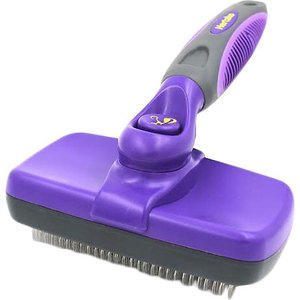
- Unique bristles gently penetrate the thick fur
- Massaging action
- Comfortable, durable, and anti-slip handle grip

- Reduces shedding up to 95 %
- Trusted by veterinarians and groomers
- Superior shedding reduction

- Specially made for dogs with sensitive skin
- Rounded head and angled pins (90 degrees)
- Metal teeth in two different lengths
The best brushes for Labs at a glance
Here’s how the eight brushes scored, highest first:
| Brush | Type | Best for | LabraJoy score | My take |
|---|---|---|---|---|
| FURminator Short Hair, Large Dog | De-shedding tool | Shedding season | 8.4 / 10 | The one I’d buy first |
| JW Pet GripSoft Double Row Undercoat Rake | Undercoat rake | Gentle undercoat work | 8.1 / 10 | Kindest on the skin |
| Hertzko Self-Cleaning Slicker | Slicker | Weekly brushing | 8.0 / 10 | Fastest to clean |
| Andis Deshedding Tool | De-shedding tool | Budget de-shedding | 7.8 / 10 | A solid FURminator rival |
| JW Pet GripSoft Slicker | Slicker | Sensitive skin | 7.4 / 10 | Gentle, but slow |
| FURemover Duo | Rubber brush | Bath time, furniture | 7.3 / 10 | Two jobs in one |
| Safari Pin and Bristle Combo | Combo brush | Finishing | 6.2 / 10 | Fine, not essential |
| Hartz Groomer’s Best Combo | Combo brush | Tight budgets | 6.1 / 10 | Cheap backup brush |
If you only buy one tool for a Lab, make it a de-shedding tool. A slicker is the second purchase, not the first.
How I tested and scored these brushes
I used each brush on a Lab’s double coat over several weeks, through a spring shed, which is when a weak brush gets found out fast. Scores come from the six weighted criteria on our review scoring page:
| Criterion | Weight |
|---|---|
| Undercoat removal | 30% |
| Skin comfort and safety | 20% |
| Build quality | 15% |
| Ease of cleaning | 15% |
| Owner comfort | 10% |
| Value | 10% |
Undercoat removal carries the most weight because that’s where a Lab’s shedding actually comes from, and it’s what you’ll care about in April. A brush that only smooths the topcoat leaves the problem underneath.
FURminator Short Hair, Large Dog (best for shedding season)
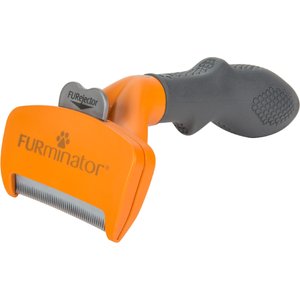
LabraJoy score: 8.4 / 10
This is the tool I’d hand any Lab owner who’s tired of vacuuming twice a day. Its stainless-steel edge reaches under the topcoat and pulls out loose undercoat without cutting the guard hairs. When I tested it, regular use made a visible difference: far less hair on the floor and a tidier coat within a couple of weeks.
FURminator says it can reduce shedding by up to 90% with regular use. I can’t measure that at home, so treat it as the maker’s claim, but I’d call it the most effective tool in this list. Make sure you buy the short-hair version, which suits a Lab’s coat. The long-hair model has longer teeth meant for fluffier breeds.
The catch is that it’s easy to overdo. Stick to the maker’s guidance of a short session once or twice a week, and stop if the skin looks pink.
| Criterion | Score |
|---|---|
| Undercoat removal | 10 |
| Skin comfort and safety | 7 |
| Build quality | 9 |
| Ease of cleaning | 8 |
| Owner comfort | 8 |
| Value | 6 |
What I like:
- The best undercoat removal I’ve had from a hand tool
- Release button pushes collected hair off the edge
- Solid build that lasts for years
What bugs me:
- Easy to overuse and irritate the skin
- The priciest brush here
Read my full FURminator review.
- Custom Design
- Efficient Grooming
- Comfort for the Dog
- Ergonomic Handle
- Specificity
- Potential Learning Curve
- Maintenance
- Frequency of Use
- Cost

JW Pet GripSoft Double Row Undercoat Rake (gentlest on the skin)

LabraJoy score: 8.1 / 10
An undercoat rake is the safer cousin of a de-shedding tool, and this one surprised me. Two rows of round-tipped teeth lift loose undercoat without the scraping feel some deshedders have. The teeth are set so they don’t rake straight down into the skin, which matters on a dog who’s touchy about grooming.
It doesn’t pull out quite as much hair per stroke as the FURminator, but you can use it more often without worrying. I’d pick it for a Lab with sensitive skin or for daily brushing during a heavy shed.
| Criterion | Score |
|---|---|
| Undercoat removal | 9 |
| Skin comfort and safety | 8 |
| Build quality | 7 |
| Ease of cleaning | 7 |
| Owner comfort | 8 |
| Value | 9 |
What I like:
- Gets deep into the undercoat with very little tugging
- Comfortable, non-slip handle
- Cheap enough to keep one in the car
What bugs me:
- Hair packs between the rows and needs picking out by hand
Read my full undercoat rake review.
- Ergonomic Design
- Dual-Function Teeth
- Safe for Skin
- Versatility
- Focused on Undercoat
- Not for Severely Matted Fur
- Potential Over-Grooming
- Durability
- Cleaning
Hertzko Self-Cleaning Slicker Brush (best everyday slicker)
LabraJoy score: 8.0 / 10
A slicker is the brush you’ll reach for most weeks of the year, and the Hertzko is the one I’d keep by the back door. Fine bent wire bristles pull loose hair and dirt out of the topcoat, and a button retracts the bristles so the hair slides off in one piece. That self-cleaning trick sounds small until you’ve spent five minutes picking hair out of a cheap slicker.
On its own it won’t clear a heavy spring shed. Pair it with a de-shedding tool or undercoat rake and you’re covered all year.
| Criterion | Score |
|---|---|
| Undercoat removal | 7 |
| Skin comfort and safety | 8 |
| Build quality | 8 |
| Ease of cleaning | 10 |
| Owner comfort | 8 |
| Value | 8 |
What I like:
- One-click cleaning, the best of any brush here
- Comfortable, anti-slip handle for long sessions
- Good at lifting dirt after muddy walks
What bugs me:
- Not a substitute for a de-shedding tool in spring
- Wire tips can scratch if you press hard
- Versatile
- Gentle on Skin
- Comfortable Grip
- Stimulates Circulation
- Bristle Durability
- Learning Curve
- No Variable Sizes

Andis Deshedding Tool (best budget de-shedder)

LabraJoy score: 7.8 / 10
The Andis does the same job as the FURminator for less money. Its curved stainless-steel edge removes a lot of dead undercoat, and when I tested it, the amount of hair it pulled out genuinely surprised me. Andis also advertises a shedding reduction of up to 90%, which again is the maker’s figure, not mine.
It isn’t quite as refined as the FURminator, though. There’s no release button, so you wipe the hair off by hand, and the edge feels a little sharper on the skin.
| Criterion | Score |
|---|---|
| Undercoat removal | 9 |
| Skin comfort and safety | 7 |
| Build quality | 8 |
| Ease of cleaning | 6 |
| Owner comfort | 8 |
| Value | 8 |
What I like:
- Pulls out a big volume of undercoat per session
- Comfortable soft-grip handle
- Good price for what it does
What bugs me:
- No hair-release button
- Needs a light hand, like any blade-style tool
- Stainless-steel
- Comfort and Control
- Versatile
- Quality Assurance
- Usage Frequency
- May Not Suit Sensitive Skin
- Limited Functionality
JW Pet GripSoft Slicker Brush (best for sensitive skin)
LabraJoy score: 7.4 / 10
If your Lab flinches at a regular slicker, this is the one to try. The rounded head and angled pins sit closer to parallel with the skin, so the brush glides rather than scratches. Two lengths of pins catch loose hair at different depths.
It’s gentle, which is the whole point, but that also means it’s slower on a thick undercoat, and you’ll notice. Think of it as a daily comfort brush, not a shedding solution.
| Criterion | Score |
|---|---|
| Undercoat removal | 6 |
| Skin comfort and safety | 9 |
| Build quality | 7 |
| Ease of cleaning | 6 |
| Owner comfort | 9 |
| Value | 9 |
What I like:
- Very gentle, good for puppies and older dogs
- The handle is one of the most comfortable here
What bugs me:
- Slow on a heavy shed
- No self-cleaning feature
Read my full JW Pet slicker review.
- Sensitive Skin-Friendly
- Angled Pins
- Comfortable Handling
- Not for Severe Mats
- One Size
- Durability
FURemover Duo (best for bath time and furniture)

LabraJoy score: 7.3 / 10
This one’s a two-sided rubber brush, and it earns its place for a different reason. The thick rubber side grips loose hair during a bath or a quick rub-down, and the finer side pulls dog hair off sofas, car seats and clothes. For a Lab household, that second side is honestly half the value.
It won’t reach deep into the undercoat like a rake. I use rubber tools the way I use a curry brush in the bath: to loosen hair, not to finish the job.
| Criterion | Score |
|---|---|
| Undercoat removal | 5 |
| Skin comfort and safety | 9 |
| Build quality | 7 |
| Ease of cleaning | 9 |
| Owner comfort | 7 |
| Value | 9 |
What I like:
- Works wet or dry, great in the bath
- Doubles as a furniture and lint brush
- Rinses clean under the tap
What bugs me:
- Only skims the undercoat
Read my full FURemover review.
- Dual Functionality
- Efficient Grooming
- Lint Removal
- Comfortable Use
- Maintenance
- Durability
- No Fur Collection
- Size
Safari Pin and Bristle Combo Brush
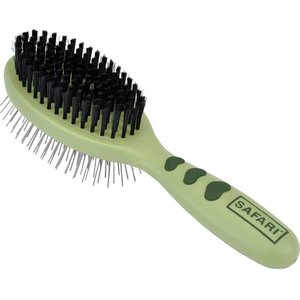
LabraJoy score: 6.2 / 10
A pin side for loose hair and debris, a bristle side for spreading the coat’s natural oils and adding shine. When I used it on a Lab, the pins did clear surface hair and dirt nicely, and the bristle side gave the coat a good finish.
The problem is the undercoat. Pin brushes are built for longer coats and don’t reach the dense layer underneath a Lab’s topcoat. It’s a pleasant finishing brush, not a shedding tool.
| Criterion | Score |
|---|---|
| Undercoat removal | 4 |
| Skin comfort and safety | 8 |
| Build quality | 6 |
| Ease of cleaning | 6 |
| Owner comfort | 7 |
| Value | 9 |
What I like:
- Two brushes for the price of one
- The bristle side leaves a nice shine
What bugs me:
- Doesn’t touch a Lab’s undercoat
- Ergonomic Design
- Dual-Function Teeth
- Safe for Skin
- Versatility
- Focused on Undercoat
- Not for Severely Matted Fur
- Potential Over-Grooming
- Durability
- Cleaning
Hartz Groomer’s Best Combo Brush

LabraJoy score: 6.1 / 10
The cheapest brush on this list, with steel pins on one side and nylon bristles on the other. It did make quick tidy-ups easier when I tested it, and the safety tips on the pins keep it gentle.
Like the Safari, it’s a surface brush, and that’s fine as long as you know it. I’d keep it as a spare in the car or for a quick brush before guests arrive, not as your main tool.
| Criterion | Score |
|---|---|
| Undercoat removal | 4 |
| Skin comfort and safety | 7 |
| Build quality | 6 |
| Ease of cleaning | 6 |
| Owner comfort | 7 |
| Value | 10 |
What I like:
- Very low price
- Comfortable handle
What bugs me:
- Little effect on shedding
- Pins bend over time
- Dual-Action
- Coat Health
- Safety
- Ergonomic Design
- Unsuitable for Short-Haired Breeds
- Maintenance
- Size
- Material
How to choose the right brush for a Lab
Labs have a short, dense double coat: a soft undercoat that does most of the shedding and a harsher, water-resistant topcoat. Different brushes work on different layers, which is why one brush rarely does it all.
Here’s how the main types compare:
| Brush type | What it does | Use it on a Lab for | Downside |
|---|---|---|---|
| De-shedding tool | Pulls loose undercoat with a fine edge | Spring and fall shedding | Easy to overuse |
| Undercoat rake | Lifts undercoat with rounded teeth | Frequent shedding sessions | Slower than a deshedder |
| Slicker brush | Fine wires lift loose hair and dirt | Weekly brushing | Can scratch if pressed hard |
| Rubber or curry brush | Loosens hair, massages | Bath time | Doesn’t reach deep |
| Pin or bristle brush | Smooths and adds shine | Finishing | Doesn’t reach the undercoat |
From my experience, the AKC’s advice on managing dog shedding matches what I’ve seen: heavy shedders may need brushing several times a week, or even daily, during peak shedding, and a coat rake or de-shedding tool removes the most loose undercoat.
Before you buy, check:
- That the tool is made for short or medium coats, not long hair
- The handle, since you’ll be holding it a lot in spring
- How the hair comes off the tool afterwards
- Whether you need one tool or a de-shedder plus a slicker
My basic kit for a Lab is simple: a de-shedding tool or undercoat rake, a slicker, and a rubber curry brush for bath time. My guide to Labrador grooming tools goes into each one in more detail.
How often should you brush a Lab?
Two or three times a week covers most of the year. During a coat blow, which usually hits in spring and fall, daily brushing for a few weeks keeps the tumbleweeds under control. Labs shed all year, so brushing never really stops, it just speeds up and slows down.
A quick routine that works:
- Start with a rubber or curry brush to loosen dead hair
- Work through the coat with a de-shedding tool or rake, following the direction of the hair
- Finish with a slicker to lift what’s left and smooth the topcoat
- Check the skin as you go for lumps, ticks or red patches
Brushing before a bath makes the bath far more effective, and my guide on how often to bathe a Labrador explains the rest of that routine.
For the full grooming picture, from nails to ears, see my grooming tips for Lab owners.
Why brushing matters beyond the hair
Brushing isn’t only about a cleaner floor. It spreads natural oils through the coat, which keeps it water-resistant and shiny. It also gives you a weekly look at your dog’s skin, and that’s how a lot of lumps, hot spots and ticks get found early.
There’s a training benefit too. A Lab who’s used to being handled during brushing is much easier at the vet, the groomer and the nail-trimming session. If you spot anything unusual on the skin while brushing, like a new lump or a red, weepy patch, show it to your vet.
FAQ
What type of brush is best for a Labrador?
A de-shedding tool or undercoat rake is best for a Lab’s undercoat, which is where most shedding comes from. Add a slicker brush for weekly topcoat brushing. Pin and bristle brushes are only for finishing.
Is the FURminator good for Labs?
Yes, the short-hair FURminator is one of the most effective de-shedding tools for Labs. Use it gently, once or twice a week, because overuse can irritate the skin. Avoid the long-hair version, which is made for fluffier breeds.
How often should I brush my Lab?
Two to three times a week for most of the year, and daily during spring and fall coat blowing. Short, regular sessions work better than one long session.
Can you brush a Lab too much?
You can overuse a de-shedding tool, which can scrape or irritate the skin. A soft slicker or rubber brush can be used daily. Stop if the skin looks red or your dog seems uncomfortable.
Should I brush my Lab wet or dry?
Use a rubber brush during a bath to loosen hair, but do most of your brushing on a dry coat. Brushing before the bath removes loose hair so shampoo reaches the skin.
My final word
If you take one thing from this guide, buy a proper de-shedding tool before anything else. A slicker and a rubber brush round out the kit, and between the three, spring stops being quite so hairy. Buck’s coat will still blow out every year, of course. It’s just much easier to stay ahead of it now.


