

Labs are hard on collars. They swim, roll in things, crash through brush and occasionally hit the end of the leash at full speed. A collar that looks great on the shelf can be a smelly, frayed mess within a season. My top pick for most Labs is a reflective collar that shrugs off water, and of the seven I tested, the Alcott reflective martingale scored highest.
One thing first, because it shapes everything below. I walk Buck on a front-clip harness and use his flat collar mainly for ID tags. A collar still matters a lot, since it’s on your dog almost all the time, but for a Lab who pulls, a harness takes the strain off the throat.
Quick note: if you buy through my links, LabraJoy may earn a small commission from Amazon or Chewy. It doesn’t change what I recommend, and it doesn’t cost you anything extra.
- Aesthetically Pleasing
- Machine Washable
- Eco-Friendly
- Handmade and Handstitched
- Comfortable
- Quality Material
The best collars for Labs at a glance
Here’s how the seven collars scored, highest first:
| Collar | Type | Best for | LabraJoy score | My take |
|---|---|---|---|---|
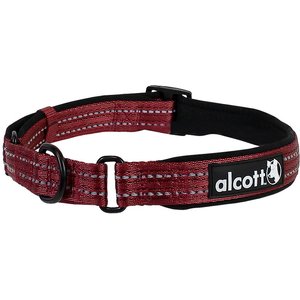
| Alcott Reflective Martingale | Martingale | Night walks, slippery heads | 7.8 / 10 | My top pick |
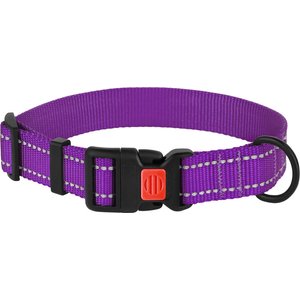
| CollarDirect Reflective Nylon | Flat buckle | Everyday wear | 7.7 / 10 | Best value |
| WANYANG Tactical | Flat with handle | Strong dogs, hiking | 7.5 / 10 | Toughest hardware |
| Frisco Nylon Martingale | Martingale | Escape artists | 7.2 / 10 | Simple and secure |
| Country Brook Woodland Camo | Martingale and leash | Matching set | 7.1 / 10 | Handmade in the USA |
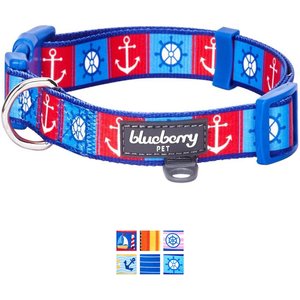
| Blueberry Pet Nautical | Flat buckle | Style | 6.9 / 10 | Pretty, plastic buckle |
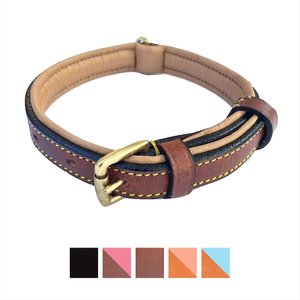
| Soft Touch Leather | Leather buckle | Dry-weather style | 6.8 / 10 | Lovely, hates water |
None of these collars is perfect, which is why the scores sit in the 7s. Each one trades something: style for water resistance, toughness for weight, price for hardware.
How I tested and scored these collars
Every collar was worn daily, including on wet walks and after swims, and I checked fit, rubbing, how the hardware held up and how fast it dried and smelled. Scores follow the collar criteria on our review scoring page:
| Criterion | Weight |
|---|---|
| Hardware strength | 25% |
| Fit and comfort | 20% |
| Water and odor resistance | 20% |
| Visibility and ID | 15% |
| Durability | 10% |
| Value | 10% |
Water gets a full fifth of the score because Labs swim. A collar that stays soggy for hours starts to smell and can irritate the skin underneath.
Alcott Reflective Martingale (best overall)
LabraJoy score: 7.8 / 10
The Alcott combines reflective stitching with soft neoprene padding, and that pairing is what pushes it to the top. When I tested it, the reflective thread lit up nicely on low-light evening walks, and the padding stayed comfortable even on long outings. It’s fully adjustable, which mattered for the Lab I tested it on, who had a talent for backing out of loose collars.
As a martingale, it tightens a little when the dog pulls back, then stops at a set limit, so it’s a secure, gentler alternative to choke and prong collars.
| Criterion | Score |
|---|---|
| Hardware strength | 7 |
| Fit and comfort | 8 |
| Water and odor resistance | 8 |
| Visibility and ID | 9 |
| Durability | 7 |
| Value | 8 |
What I like:
- Reflective stitching for dark mornings and evenings
- Neoprene padding dries faster than webbing
- Stops a Lab from slipping out backward
What bugs me:
- Like any martingale, it shouldn’t be left on in the crate or unsupervised
- Reflective Stitching
- Comfortable
- Secure
- Easy Attachment
- Dries Quickly
- Plastic Parts
- Potential Confusion in Sizing
- No Buckle for Easy Removal
CollarDirect Reflective Nylon Collar (best value)
LabraJoy score: 7.7 / 10
A plain, well-made flat collar at a very fair price. The soft nylon was gentle on the skin of the Lab I tested it on, who had sensitive skin, and it caused no irritation. The bright orange didn’t fade over time, and the reflective strip adds real visibility on evening walks.
It doesn’t do anything fancy, and that’s the point. For an everyday ID collar, I’d be happy with this one.
| Criterion | Score |
|---|---|
| Hardware strength | 7 |
| Fit and comfort | 8 |
| Water and odor resistance | 7 |
| Visibility and ID | 9 |
| Durability | 7 |
| Value | 9 |
What I like:
- Gentle on sensitive skin
- Color held up well, and the reflective strip helps at night
- Very good price
What bugs me:
- Basic hardware, fine for ID but not for heavy pulling
- Reflective
- Non-allergic
- Color Retention
- Cost-Effective
- Aesthetically Pleasing
- Plastic Clasp
- Clasp Malfunction
- Durability Issues
WANYANG Tactical Collar (toughest hardware)

LabraJoy score: 7.5 / 10
If your Lab is strong and you want something that feels nearly indestructible, the WANYANG Tactical Collar is the one. It has a heavy-duty metal buckle, a padded inner cushion and a built-in grab handle. When I tested it, the handle was genuinely useful for holding a dog close at the vet or by a busy road.
It’s heavier and bulkier than a regular collar, so I’d save it for outings rather than all-day wear. Some owners find it too bulky for smaller-necked dogs, and I can see why.
| Criterion | Score |
|---|---|
| Hardware strength | 9 |
| Fit and comfort | 8 |
| Water and odor resistance | 6 |
| Visibility and ID | 5 |
| Durability | 9 |
| Value | 8 |
What I like:
- Metal buckle and very strong webbing
- Handle for quick control
- Inner cushion keeps it comfortable
What bugs me:
- Heavy for 24/7 wear
- Holds water longer than neoprene
- Handle
- Heavy-Duty Metal Buckle
- Material
- Quick Release
- Triple Security
- Comes with Patches
- Multiple Control Methods
- Sturdiness
- Durability Concerns
Frisco Nylon Martingale with Buckle (best for escape artists)
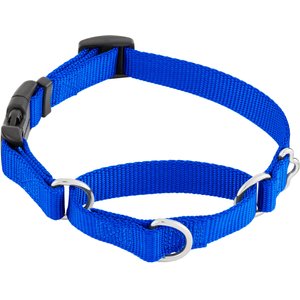
LabraJoy score: 7.2 / 10
The Frisco is a simple martingale with a side-release buckle, which makes it much easier to put on than a slip-over martingale. Frisco says the webbing is tested to hold up to seven times the recommended weight for each size. When I tested it, the double-loop design gave good control on walks, and it’s well suited to dogs with narrower heads that tend to slip collars.
There’s also a separate ring for ID tags, so the tags don’t jangle against the leash clip.
| Criterion | Score |
|---|---|
| Hardware strength | 7 |
| Fit and comfort | 8 |
| Water and odor resistance | 7 |
| Visibility and ID | 5 |
| Durability | 8 |
| Value | 9 |
What I like:
- Buckle makes it quick to put on
- Dedicated ID ring
- Good price
What bugs me:
- No reflective trim
- Convenience
- ID Tag Ring
- Aesthetics
- Cleaning
- Safety
- Versatile Design
- Durability with Chewers
- Color Fading
Country Brook Design Woodland Camo Martingale and Leash (best matching set)
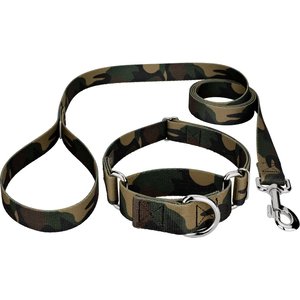
LabraJoy score: 7.1 / 10
Country Brook makes these by hand in the USA, and it shows in the stitching. You get a martingale collar plus a matching 6-foot leash, which is a sensible length for everyday walking. When I tested it, the martingale gave gentle feedback when a curious Lab tried to pull away, and the medium size fit the Lab I tested it on well.
The camo pattern is fun, but it does the opposite of what you want on a dark road, so I’d add a light or reflective tag.
| Criterion | Score |
|---|---|
| Hardware strength | 7 |
| Fit and comfort | 8 |
| Water and odor resistance | 7 |
| Visibility and ID | 5 |
| Durability | 8 |
| Value | 8 |
What I like:
- Handmade in the USA with solid stitching
- Comes with a matching 6-foot leash
What bugs me:
- Camo is hard to see at night
Blueberry Pet Nautical Collar (best for style)
LabraJoy score: 6.9 / 10
The Blueberry Pet collar is the prettiest collar on this list. A grosgrain ribbon is sewn onto high-density polyester, and the nautical patterns are charming on a yellow or black Lab. It’s machine washable, which is a big plus for a swimmer, and the D-ring is nickel coated.
The weak spot is the plastic buckle. It’s fine for an ID collar on a polite dog, but I wouldn’t trust it on a Lab who lunges.
| Criterion | Score |
|---|---|
| Hardware strength | 6 |
| Fit and comfort | 8 |
| Water and odor resistance | 7 |
| Visibility and ID | 5 |
| Durability | 7 |
| Value | 9 |
What I like:
- Lovely patterns and colors
- Machine washable
What bugs me:
- Plastic buckle, not for strong pullers
- Eco-Friendly
- Durable
- Aesthetically Pleasing
- Machine Washable
- Matching Leash Available
- Plastic Buckle
- Plastic Tag Holder
Soft Touch Leather Collar (best for dry-weather style)
LabraJoy score: 6.8 / 10
This is a beautiful collar. It’s handmade and hand-stitched from sealed-edge, full-grain leather lined with soft sheepskin leather, and the solid brass hardware won’t rust. When I tested it, it caused no chafing or irritation, and the small brass ring keeps ID tags separate from the leash ring.
So why does it score lowest? Water. Leather and Labs don’t mix well. A collar that gets soaked every week stiffens and can start to smell, which is why it loses most of its points on water resistance.
| Criterion | Score |
|---|---|
| Hardware strength | 9 |
| Fit and comfort | 9 |
| Water and odor resistance | 3 |
| Visibility and ID | 5 |
| Durability | 8 |
| Value | 6 |
What I like:
- Gorgeous craftsmanship and brass hardware
- Very comfortable lining
What bugs me:
- Doesn’t suit a dog who swims
- Pricier than nylon options
- Handmade and Handstitched
- Aesthetic Appeal
- Separate Ring for Tags
- Comfortable
- Quality Material
- Not Suitable for Wet Conditions
- Price
What size collar does a Lab need?
Measure, don’t guess. Most adult Labs have a neck size somewhere around 18 to 24 inches, but builds vary a lot between field and show lines, males and females.
How to measure:
- Wrap a soft tape measure around the middle of the neck, where the collar will sit
- Slide two fingers under the tape, then read the measurement
- Pick a collar whose adjustment range puts your measurement in the middle, not at the very end
- Recheck the fit monthly for puppies and after any weight change
The two-finger rule is the one to remember. Tighter and the collar will rub. Looser and a Lab can back out of it. For growing dogs, my guide on what collar size a Labrador puppy needs has a size-by-age chart.
Types of collars for Labs
Here’s how the main types compare:
| Collar type | How it works | Best for | Watch out for |
|---|---|---|---|
| Flat buckle | Fixed size, buckle or clip | ID tags, everyday wear | Dogs can slip out if loose |
| Martingale | Tightens to a set limit | Slippery or narrow heads | Remove when unsupervised |
| Leather | Flat buckle in leather | Style, dry climates | Doesn’t like water |
| Tactical | Heavy webbing, metal buckle, handle | Strong dogs, outings | Heavy for all-day wear |
| Choke, prong or shock | Pain or pressure to correct | Not recommended | Can injure the neck and damage trust |
I don’t recommend choke, prong or shock collars. They work by causing discomfort, and reward-based training gets better, safer results with Labs. If pulling is the problem, a front-clip harness is the better tool.
From my experience, most Lab owners end up using both: a harness for walks and a flat collar for tags. My Labrador harness guide compares a harness with a flat collar in detail.
Collar materials and what they mean for a Lab
Based on my research and a lot of soggy collars, material decides how a collar handles water, mud and time. For a breed that swims, that’s the first thing I’d look at.
- Nylon: strong, cheap and adjustable, with lots of reflective options. It holds water and can smell if it’s always wet, so wash it regularly.
- Polyester and ribbon: similar to nylon, often prettier, usually machine washable.
- Neoprene padding: soft and quick to dry, a good choice for swimmers.
- Biothane or coated webbing: waterproof and wipe-clean. Not in this test, but worth a look for dogs who live in the water.
- Leather: comfortable and long-lasting when kept dry, but it stiffens and smells if soaked often.
Whatever you pick, look at the hardware. Metal buckles and welded D-rings outlast plastic, especially on a strong dog.
Collar safety tips
A few habits keep a collar safe:
- Take collars off in the crate, where tags and loops can snag on wire
- Never leave a martingale on an unsupervised dog
- Check the skin under the collar weekly, especially after swims
- Wash nylon collars every few weeks to stop odor and skin irritation
- Keep ID tags and a microchip up to date, since a collar can come off
The microchip point matters more than people think. Collars break and get pulled off, and a chip is the backup that gets a lost Lab home.
FAQ
What is the best type of collar for a Labrador?
For everyday wear, a flat nylon or neoprene collar with reflective trim and solid hardware. If your Lab slips out of collars, a martingale is a good choice for walks. For dogs that pull, add a front-clip harness.
What size collar does an adult Lab need?
Most adult Labs need a collar that fits a neck of roughly 18 to 24 inches. Measure the middle of the neck, allow two fingers of space, and choose a size that puts your number in the middle of the adjustment range.
Are martingale collars safe for Labs?
Yes, when fitted correctly and used on walks. They tighten only to a set limit, so they don’t choke like a slip collar. Take them off when your dog is home alone or in a crate.
Should my Lab wear a collar all the time?
Many owners keep a flat ID collar on during the day, but take it off in the crate and at night if your dog sleeps unsupervised. Never leave a martingale or training collar on unattended.
Are leather collars good for Labs?
They’re comfortable and durable, but they don’t handle frequent swimming well. For a water-loving Lab, nylon, neoprene or a waterproof coated collar is the more practical choice.
My final word
For most Labs, I’d buy a simple reflective collar with metal hardware for everyday ID and pair it with a front-clip harness for walks. Wash it often, check the fit monthly and keep the tags current. Buck’s collar has seen more lake water than most fishing boats, and that’s exactly why I care about how fast a collar dries.


